Ford Flathead engine identification – Part I
Month ago, I found myself in trouble identifying Ford Flathead V8 engines. While I was looking for a replacement engine, I found many offers with a description like „pulled out of a truck“ or „8CM from a 1950 F1“. Most times more information about the car it was pulled from, than the engine itself. „8CM from a 1950 F1“ – with other words: I have no idea what I’m selling. Yes, the 8CM fits in a Ford F1, but the correct engine is the 8RT. Most times I had to identify the engines based on tiny smartphone photos.
Here we go, part one in identifiying Ford Flathead V8 engines…
Count the studs/head nuts
One simple characteristic of a Ford Flathead is the number of head nuts per cylinder. If someone is talking about a 24-stud, he means an engine with 24 head nuts (or 24 studs in the block). Ford has build several cylinderheads, but only 4 different heads in count of the head nuts: 17, 21, 24 and 27. If the count is 17, you have the smallest of all flatheads, the 60 HP and 136 cui flathead that was build from 1937 to 1940. 21 studs where build from 1932 to 1938. The early engines have 65 or 75 HP, all later engines have 85 HP and 221 cui. If your count is 27 you have a real monster. These Flatheads were build for big Ford trucks (F7, F8) or Lincolns. They have up to 154 HP and 337 cui. If you count 24…you can have anything else and we need to look closer.

| studs | cui | HP | build from | build to |
|---|---|---|---|---|
| 17 | 136 | 60 | 1937 | 1940 |
| 21 | 221 | 65/75/85 | 1932 | 1938 |
| 24 | 221/239/255 | 85/90/95/100/110/125 | 1938 | 1953 |
| 27 | 337 | 154 | 1948 | 1951 |
Stroke and bore
If possible, measure the bore and stroke. The bore is the diameter of a cylinder and the stroke is the way a piston goes up and down. The different displacement of the 24 stud engines can be determined by these two values. The stroke can be 3.200, 3.750, 4.000 or 4.375 inch. The bore can be 2.6000, 3.0625, 3.1875 or 3.5000 inch, but these values can varies when the cylinder is bored for oversize pistons or cylinder sleeves. If the bore is somewhere between 3.0625 and 3.1875 inch, it must be a 221 cui Flathead. Let’s expand the above table:
| studs | cui | HP | build from | build to | bore | stroke |
|---|---|---|---|---|---|---|
| 17 | 136 | 60 | 1937 | 1940 | 2.6000 | 3.2000 |
| 21 | 221 | 65/75/85 | 1932 | 1938 | 3.0625 | 3.7500 |
| 24 | 221 | 85/90 | 1938 | 1942 | 3.0625 | 3.7500 |
| 24 | 239 | 95/100/110 | 1939 | 1953 | 3.1875 | 3.7500 |
| 24 | 255 | 110/125 | 1949 | 1953 | 3.1875 | 4.0000 |
| 27 | 337 | 154 | 1948 | 1951 | 3.5000 | 4.3750 |
Differences in construction details
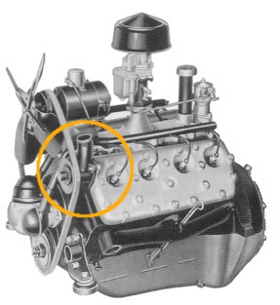
Differences in construction details can be seen even if you have a smal photo. Let’s take a look at the 21 stud Flatheads. The early engines from 1932 to 1936 had Waterpumps mounted to the cylinderheads with the water outlet on the pump. 1937 and 1938 models have the waterpumps mounted to the engine body.
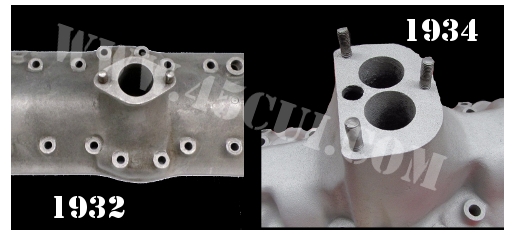
If the intake manifold is present, look at the studs the carburetor is mounted. If there are two studs, it’s a 1932 or 1933 intake manifold for a Detroit Lubricator carburetor. The manifold is made of aluminium. If there are three studs, it’s for a Stromberg carburetor 1934 and up (see picture below article).
1932 models have iron heads, 1933 models have aluminium heads, giving the 10 HP more power.
| studs | cui | HP | build from | build to | bore | stroke | construction details | model |
|---|---|---|---|---|---|---|---|---|
| 17 | 136 | 60 | 1937 | 1940 | 2.6000 | 3.2000 | 74 | |
| 21 | 221 | 65 | 1932 | 1932 | 3.0625 | 3.7500 | waterpumps in heads, 2 stud carb. mount, iron heads | 18 |
| 21 | 221 | 75 | 1933 | 1933 | 3.0625 | 3.7500 | waterpumps in heads, 2 stud carb. mount, alu heads | 40 |
| 21 | 221 | 85 | 1934 | 1936 | 3.0625 | 3.7500 | waterpumps in heads, 3 stud carb. mount, alu heads | 40a, 48, 68 |
| 21 | 221 | 85 | 1937 | 1937 | 3.0625 | 3.7500 | waterpumps in block, 3 stud carb. mount, alu or iron heads | 78 |
| 21 | 221 | 85 | 1938 | 1938 | 3.0625 | 3.7500 | waterpumps in block, 3 stud carb. mount, iron heads | 81a |
| 24 | 221 | 85/90 | 1938 | 1942 | 3.0625 | 3.7500 | ||
| 24 | 239 | 95/100/110 | 1939 | 1953 | 3.1875 | 3.7500 | ||
| 24 | 255 | 110/125 | 1949 | 1953 | 3.1875 | 4.0000 | ||
| 27 | 337 | 154 | 1948 | 1951 | 3.5000 | 4.3750 |
Part II will follow…